
Lab 02 · a concept field kit
Shrike
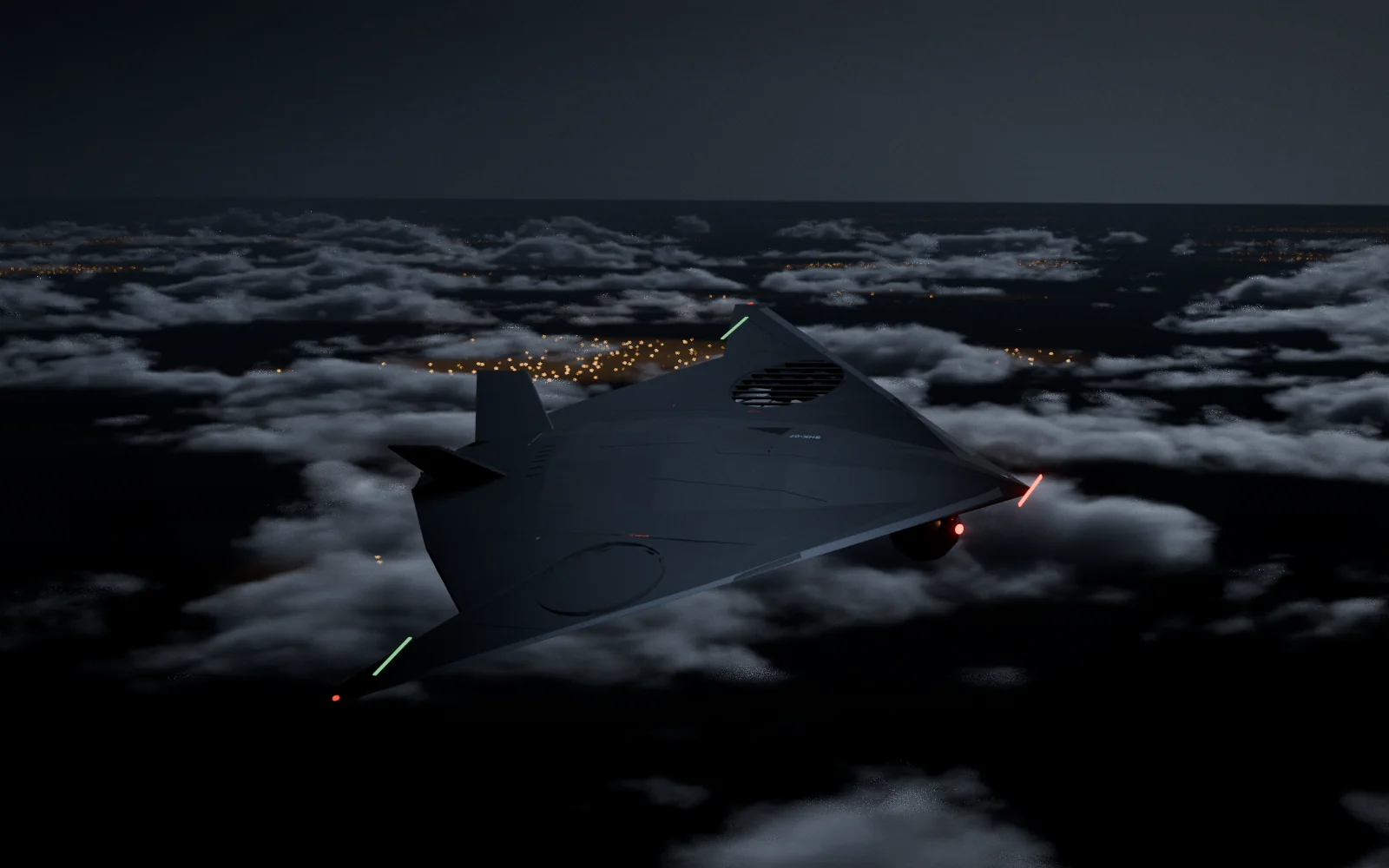
A 96 cm stealth drone and everything it needs to fly tonight, in one case.
55.8° N · 12.3° E · 23:48 · 6 °C · rain1200 × 940 × 348 mm
28.9 kg packed
Shrike, eo/ir ball, 4 packs
Ground station, 2 spare rotors
- 01
Flat facets
Every surface is a flat plane. A flat face throws radar off in one direction, away from whoever sent it; a curve always sends some back.
- 02
Few angles
The leading edges, the sawtooth trailing edge and the ends of every door keep to a few angles, so its radar return is a few narrow spikes instead of a glow.
- 03
Fans in the wings
Two fans buried in the wings lift it straight up, under louvres that turn the air. Nothing turns in the open.
- 04
The bay
Behind two doors with sawtooth ends. With the EO/IR ball under the nose the bay rides empty; it is there for the mapping camera or the relay.
- 05
The EO/IR ball
Under the nose, a colour, a low-light and a thermal camera on a two-axis gimbal. Keep scrolling to look through it.
- HDG
- ALT
- M
- GS
- KM/H
- Elevons
Your pointer is the stick · A D W S
- Brief
- I wanted to make a stealth drone something you could actually buy, and make the interaction good enough that you want to see more, then want one. Shrike is a 96 cm flying wing that ships as a complete kit in one case: open it, build your kit, fly it, look through its sensor and pack it away. The foam, the flight, the sensor and the label all follow what you chose.
- Client
- Tornskade, an imagined Copenhagen maker. The drone, the kit and the numbers are a concept.
- Role
- Concept, 3D, interface, motion, sound and code.
- Deliverables
- A live 3D configurator; the drone, the case and the kit built by script; three sensor views; a spec sheet and case label made from the configuration; generated sound.
- Model
- Blender, built by Python from one file of dimensions: Shrike in 46 parts with its doors, elevons, gear, fans and gimbal free to move; the case, the foam’s pockets and every part of the kit the same way.
- Live
- The case on WebGPU, its shaders in TSL, with a WebGL2 fallback; the foam cut in the browser from the kit you build. The flight and the sensors on WebGL2: live cumulus raymarched over an imagined coast, and a world in GLSL where every surface writes its colour, its light and its temperature, so the sensor reads it as a day camera, a low-light camera or a thermal camera.
- Tech
- Blender, Python, three.js (WebGPU, TSL, WebGL2), GLSL, Web Audio, React
- Year
- 2026