Matter · 01
Accretion disk
The bright ring of gas round the hole
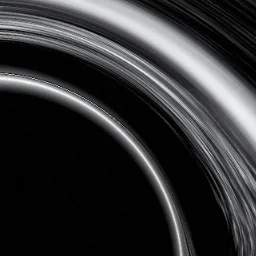
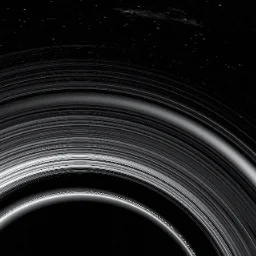
Gas and dust spiralling inwards, squeezed and heated by friction to millions of degrees until it glows. Nothing here is lit from outside: the disk is its own light.
In this renderA flow map over baked noise, moved in two phases so it never smears.
Light · 02
Gravitational lensing
The arc over the top of the shadow
The far side of the disk, behind the hole, is bent over the top and under the bottom by gravity. You see the back of the disk without going round it.
In this renderEvery pixel's light ray is traced through curved spacetime in its own orbital plane.
Light · 03
Doppler beaming
The brighter side of the disk
The disk turns so fast that the side coming towards you is brighter and bluer, and the side moving away is dimmer and redder.
In this renderEach point of the disk is brightened by the fourth power of its Doppler factor.
Light · 04
Photon ring
The thin line round the shadow
Light that has circled the hole once before escaping to you. It is the closest light can pass and still get away.
In this renderRays that pass near 1.5 horizon radii orbit before leaving; their piled-up light draws the ring.
Spacetime · 05
The shadow
The black disc itself
The black disc is not the horizon. It is about 2.6 times bigger, because light passing within that distance is caught.
In this renderThe shadow's radius is the critical impact parameter, √27 ⁄ 2 horizon radii.
Matter · 06
Innermost stable orbit
The disk's sharp inner edge
Nothing can orbit closer than three times the horizon's radius. Inside this edge gas stops circling and plunges.
In this renderThe disk's inner radius is set at three horizon radii, the last stable orbit of a black hole that doesn't spin.
Light · 07
Gravitational redshift
The dimmer, warmer inner disk
Light climbing out of the deep well loses energy on the way, so the inner disk looks redder and dimmer than it really is.
In this renderEach ray's colour and brightness are shifted by the redshift at the point it came from.
Matter · 08
Spaghettification
The streaks falling into the inner disk
Close in, gravity pulls much harder on the near end of anything than on the far end. Clumps of gas are stretched into streaks as they fall.
In this renderHot spots are sheared along their orbits as they spiral inwards.
Matter · 09
Jets
The beams from the poles
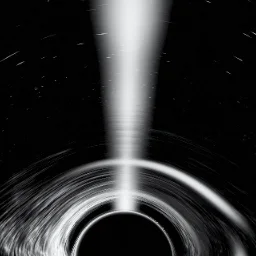
Magnetic fields can launch narrow jets of plasma from the poles at nearly the speed of light, reaching far beyond the galaxy.
In this renderTwo beams along the spin axis, bent by the same lensing as everything else.
Spacetime · 10
Time dilation
The clock on the right edge
Clocks run slower close to a black hole. Hovering here, the clock below compares a second for you with a second for someone far away.
Here: 0.0 s · far away: 0.0 s
In this renderThe clock uses √(1 − Rs ⁄ r) for the camera's distance r.
Spacetime · 11
Event horizon
Where the dark begins
The point of no return, hidden inside the shadow at well under half its size. Inside it every path leads further in, even for light.
In this renderThe horizon radius is the scene's unit of length: everything else is measured in it.
Spacetime · 12
Inside
The window behind you
Past the horizon the universe you came from shrinks to a bright window behind you. This one is an illustration: nobody can come back to check.
In this renderThe camera turns round and the outside is squeezed towards a point.